Table of Contents
Toggle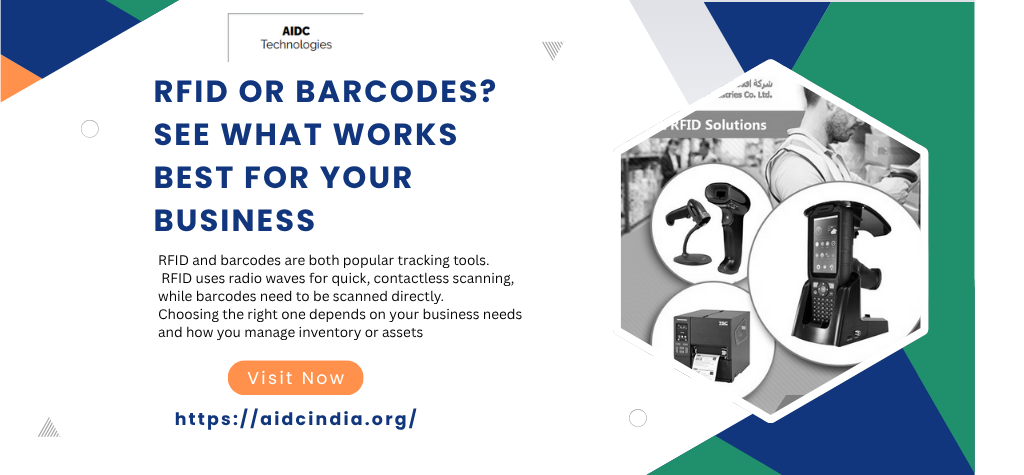
In today's fast-paced world, businesses rely on technology like RFID systems and barcode solutions for efficient tracking and inventory management. While both serve similar purposes, they operate in distinct ways. RFID Definitions explain how radio frequency is used to identify and track items automatically, without needing direct line-of-sight. In contrast, barcodes must be scanned one at a time. Understanding these differences helps businesses choose the best solution based on their needs for speed, accuracy, and automation.
What is RFID Technology?
RFID definitions describe a technological system that automatically identifies and records data using radio waves. RFID (Radio Frequency Identification) is an advanced tracking solution that’s widely used across industries like logistics, healthcare, manufacturing, and retail. It includes three essential components:
- RFID Tags – Tiny chips with antennas that store unique data (available in passive or active forms) Devices that collect and transmit tag data to a database or software system
- RFID Antennas –make it possible for tags and readers to talk to each other wirelessly.
Unlike traditional barcodes, RFID Definitions demonstrate that RFID systems don’t require line-of-sight, enabling multiple items to be scanned simultaneously. This makes RFID ideal for fast, efficient, and automated inventory management.
Key Advantages of RFID:
Based on industry-backed RFID Definitions, the technology offers several unique advantages:
- Enhanced security with encryption capabilities
- Longer read range (several meters)
- Dynamic data storage and modification
What is Barcode Technology?
Barcodes, which use black-and-white lines or patterns like QR codes, are a way to show info visually. In contrast to RFID Definitions, which describe a wireless and automated system, barcodes require physical scanning using handheld devices. Common types include:
- 1D Barcodes - Linear codes for retail/product labeling (UPC)
- 2D Barcodes - Higher capacity codes (QR codes)
While cost-effective, barcodes require line-of-sight scanning and are susceptible to wear.
RFID vs Barcode: Key Differences
| Feature | RFID Technology | Barcode Technology |
|---|---|---|
| Data Storage | Large capacity (per RFID Definitions) | Limited capacity |
| Scanning Method | No line-of-sight needed | Direct scanning required |
| Speed | Multiple simultaneous reads | Single-item scanning |
| Durability | Long-lasting tags | Prone to damage |
| Cost | Higher initial investment | Cost-effective |
Technology Benefits Comparison
RFID Advantages
According to reliable RFID Definitions, RFID delivers:
- Automated bulk scanning
- Real-time tracking
- Higher data accuracy
- Wide industry applications
Barcode Advantages
- Lower implementation cost
- Universal compatibility
- Simple setup
- No power requirement
When to Use Each Technology?
Choose RFID When:
- Automated tracking is needed
- Real-time data is critical
- Managing large-scale inventory
- In logistics, healthcare, or security
Choose Barcode When:
- Cost is a primary concern
- Manual scanning suffices
- For retail or small business needs
- Simple tracking is adequate
Many businesses use hybrid solutions combining both technologies for optimal efficiency.
Future of Tracking Technologies
Looking forward, the future of tracking technologies is promising. RFID Definitions are evolving with the rise of IoT, AI, and cloud integration, which enhance automation, data visibility, and operational intelligence. Barcodes, on the other hand, continue to remain vital for businesses that prioritize simplicity and cost. In 2025 and beyond, more businesses are expected to adopt hybrid systems that combine the strengths of both technologies for maximum productivity.
Conclusion
Ultimately, the decision between RFID and barcode technologies depends on your business needs, goals, and resources. RFID Definitions highlight the advantages of fast, real-time, and bulk scanning, making RFID ideal for larger, more complex operations. Barcodes, meanwhile, remain a reliable, cost-effective option for smaller setups. Many businesses find success by integrating both systems into their workflows.
Need expert advice on choosing between RFID and barcode technology? Contact us for personalized guidance.
FAQs
1. What is RFID and how does it work?RFID Definitions explain that RFID uses radio signals to read and store data from tags on objects—without direct contact or line-of-sight
2. Are barcodes still useful today?According to RFID Definitions, RFID is significantly faster since it can scan multiple items at once
3. Which is faster: RFID or barcodes?RFID is faster. It can read multiple items at once, while barcodes need to be scanned one by one
4. Is RFID more expensive than barcodes?Yes, RFID costs more upfront but can save time and effort in the long run, especially for large inventories
5. How can AIDC Technologies India help?AIDC Technologies India delivers custom RFID and barcode solutions that enhance tracking, streamline inventory, and align with RFID Definitions and best industry practices.