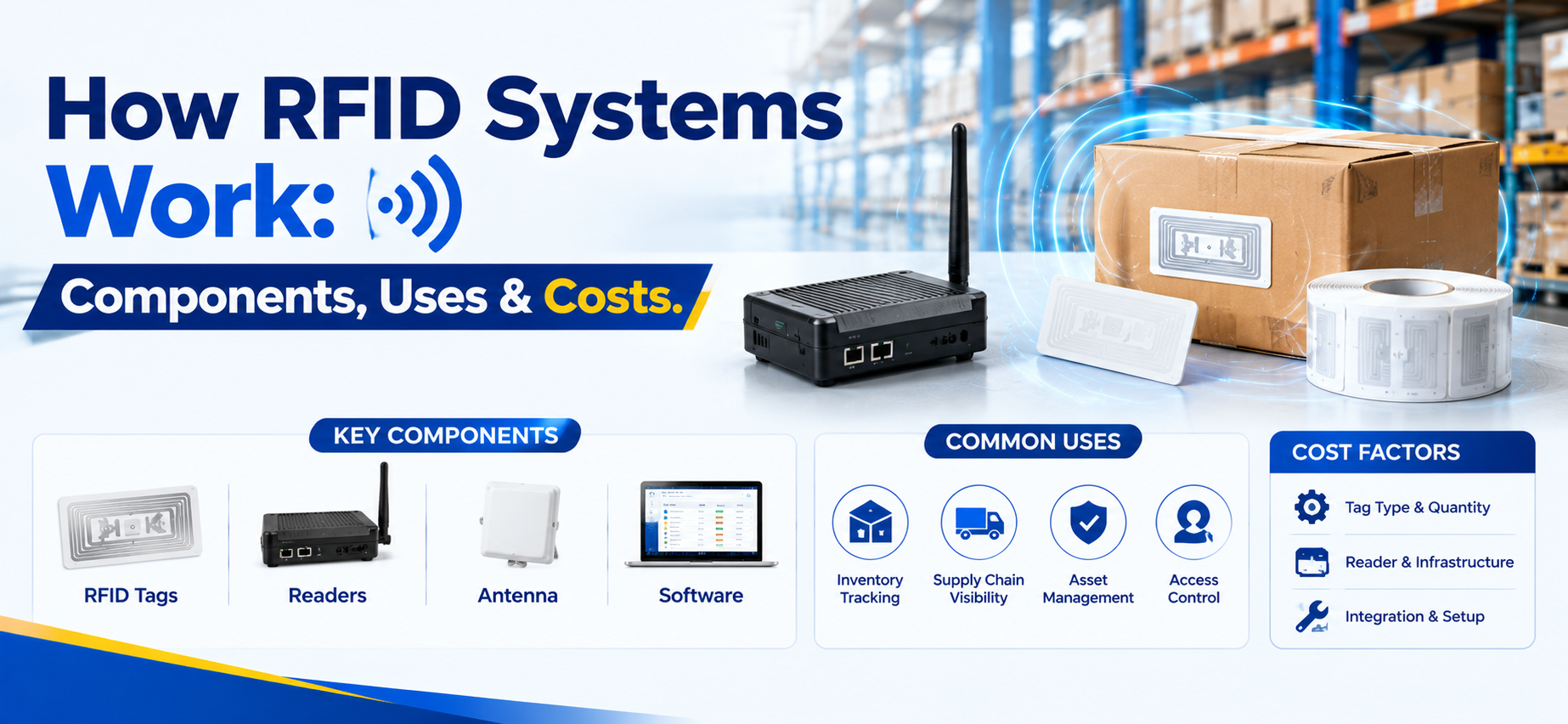
Businesses need accurate information about their inventory, equipment, and valuable assets to manage daily operations efficiently. Manual stock counting and barcode scanning can take time, especially when organizations handle thousands of products across warehouses, retail stores, and distribution centres. RFID Systems offer a practical way to identify and track tagged items using radio waves, helping businesses improve visibility and reduce manual work.
AIDC Technologies provides automatic identification and data capture solutions, including RFID and barcode technologies, to support inventory control, asset management, and operational efficiency. Understanding how RFID works, what components are required, and how much implementation may cost can help businesses make informed decisions.
What Are RFID Systems?
RFID stands for Radio Frequency Identification. RFID Systems use radio waves to identify objects fitted with compatible RFID tags. Unlike traditional barcode scanning, RFID technology can read multiple compatible tags without requiring direct line of sight, depending on the tag type, reader, environment, and system configuration.
A typical RFID setup includes tags, readers, antennas, and software. The tags contain identification data, the reader communicates with them, and the software processes the collected information.
Businesses use RFID technology to monitor stock movement, locate equipment, manage products, and improve record accuracy. It is useful in retail, healthcare, manufacturing, logistics, libraries, and warehouse operations.
How Do RFID Systems Work?
RFID works through a simple process that connects tagged items with a reader and a software platform.
First, an RFID tag is attached to a product, container, document, or asset. When the item enters the reader’s operating range, the reader sends radio signals through an antenna. A compatible tag responds with its stored identification information.
The reader receives the response and transfers the data to connected software. The software can then update inventory records, register an item’s movement, or display relevant information to authorized users.
For example, a warehouse can use RFID to record tagged goods passing through a receiving area. Staff can check incoming stock more efficiently instead of scanning every item individually. However, read accuracy depends on tag placement, materials, interference, and system design.
Main Components of an RFID System.
Understanding the essential RFID system components helps businesses choose suitable equipment.
- RFID Tags: These tags store identification data and are attached to items. Passive tags use energy from the reader’s radio signal, while active tags use an internal battery. The right tag depends on the application, reading distance, environment, and budget.
- RFID Readers: RFID readers communicate with tags and collect their identification data. Fixed readers are common at warehouse entrances and production lines, while handheld readers help staff check stock or locate tagged assets.
- RFID Antennas: RFID antennas transmit and receive radio signals between readers and tags. Antenna placement and configuration influence the coverage area and reading performance.
- RFID Software: Software processes collected information and makes it useful for daily operations. Depending on the solution, it may connect with inventory databases, asset management platforms, or a warehouse management system.
- Integration and Network Infrastructure: Cables, connectivity, middleware, and system integration help transfer data between RFID equipment and business applications. These elements should be planned according to operational requirements.
Common Uses of RFID Systems.
RFID inventory management helps businesses maintain better visibility of stock across warehouses, stores, and distribution centres. Staff can identify tagged products, record movements, and compare physical stock information with digital records.
In manufacturing, RFID supports the tracking of tools, components, work-in-progress, and finished goods. This can help teams understand where items are located during production.
RFID asset tracking allows organizations to identify and monitor equipment such as laptops, medical devices, tools, and reusable containers. It can reduce time spent searching for assets and help maintain reliable records.
Retailers can use RFID to improve stock visibility, support stocktaking, and monitor product movement. Hospitals and libraries can apply RFID to manage equipment, books, files, and other tagged items.
Logistics companies can use RFID to record goods moving through selected checkpoints. The information can support shipment visibility and improve coordination between operational teams.
Benefits and Challenges of RFID Systems.
One major benefit of RFID is faster data collection. Depending on the setup, readers can identify multiple tags in a single reading cycle without scanning each label individually. This can reduce repetitive tasks and improve inventory workflows.
RFID can also improve stock visibility, support asset accountability, and reduce some manual data-entry errors. Integration with existing software can help businesses make better use of collected information.
However, RFID is not suitable for every situation without careful planning. Initial equipment and integration expenses may be higher than those of a basic barcode setup. Metal surfaces, liquids, signal interference, unsuitable tags, and poor antenna placement can also affect performance.
Businesses should test RFID equipment in their actual operating environment before deployment. Comparing RFID with barcode solutions can help determine which technology—or combination of both—best meets their needs.
RFID System Costs: What Should Businesses Consider?
The RFID implementation cost varies according to the size and complexity of the project. There is no single price that suits every business because equipment, coverage, tag quantities, and software requirements differ.
Important cost factors include:
- RFID tags: The price depends on tag type, quantity, durability, and application.
- Readers and antennas: Fixed readers, handheld devices, and antenna configurations affect equipment expenses.
- Software and integration: Connecting RFID data with existing business systems can require additional development and configuration.
- Installation and testing: Site surveys, installation, calibration, and pilot testing contribute to project costs.
- Maintenance and training: Staff training, equipment support, and future replacements should be included in the budget.
For better cost control, businesses should identify the problem they want to solve, select a suitable application, and begin with a focused pilot project. AIDC Technologies can help businesses assess identification and tracking requirements when considering RFID and barcode solutions.
How to Choose the Right RFID Solution
Start by defining whether your priority is inventory control, asset tracking, product identification, or shipment visibility. Next, consider the operating environment, required reading distance, number of items, and existing software.
Evaluate tag compatibility, reader performance, data security, and integration requirements before selecting equipment. A small pilot can reveal practical issues and help measure results before a wider rollout.
Choosing a solution based on business needs rather than equipment specifications alone can help organizations avoid unnecessary expenses and achieve more useful results.
Conclusion
RFID Systems help businesses identify products, track assets, and improve inventory visibility through automated data collection. Understanding the components, applications, limitations, and implementation costs makes it easier to select a solution that meets operational needs.
AIDC Technologies supports businesses exploring RFID and barcode solutions for inventory management, asset tracking, and identification workflows. Assess your requirements and choose a system that delivers practical value to your operations.
Explore reliable RFID and barcode solutions at KMS Barcode to improve inventory tracking, product identification, and warehouse efficiency.
. Visit AIDC Technologies for barcode scanners, RFID technology, and identification solutions that help businesses streamline inventory and asset management.
Frequently Asked Questions
- What are RFID Systems used for?
RFID Systems identify and track tagged products, equipment, documents, and assets. Common applications include inventory management, warehouse operations, retail, healthcare, manufacturing, and logistics.
- How do RFID Systems work?
An RFID reader sends radio signals to compatible tags. The tags respond with identification data, which the reader transfers to software for processing and tracking.
- What are the main components of an RFID system?
The main components are RFID tags, readers, antennas, software, and the required connectivity or integration infrastructure.
- How much does an RFID system cost?
Costs depend on the number and type of tags, readers, antennas, software, installation, and integration requirements. A site assessment and pilot project can help establish a realistic budget.
- Are RFID Systems better than barcodes?
RFID can read multiple compatible tags without direct line of sight, while barcodes are often more economical for simple identification tasks. The better option depends on the application, operating environment, and budget.
- Can RFID Systems improve inventory accuracy?
Yes. Properly configured RFID can automate data collection, improve stock visibility, and reduce manual recording errors. Results depend on tag quality, system configuration, and operational processes.