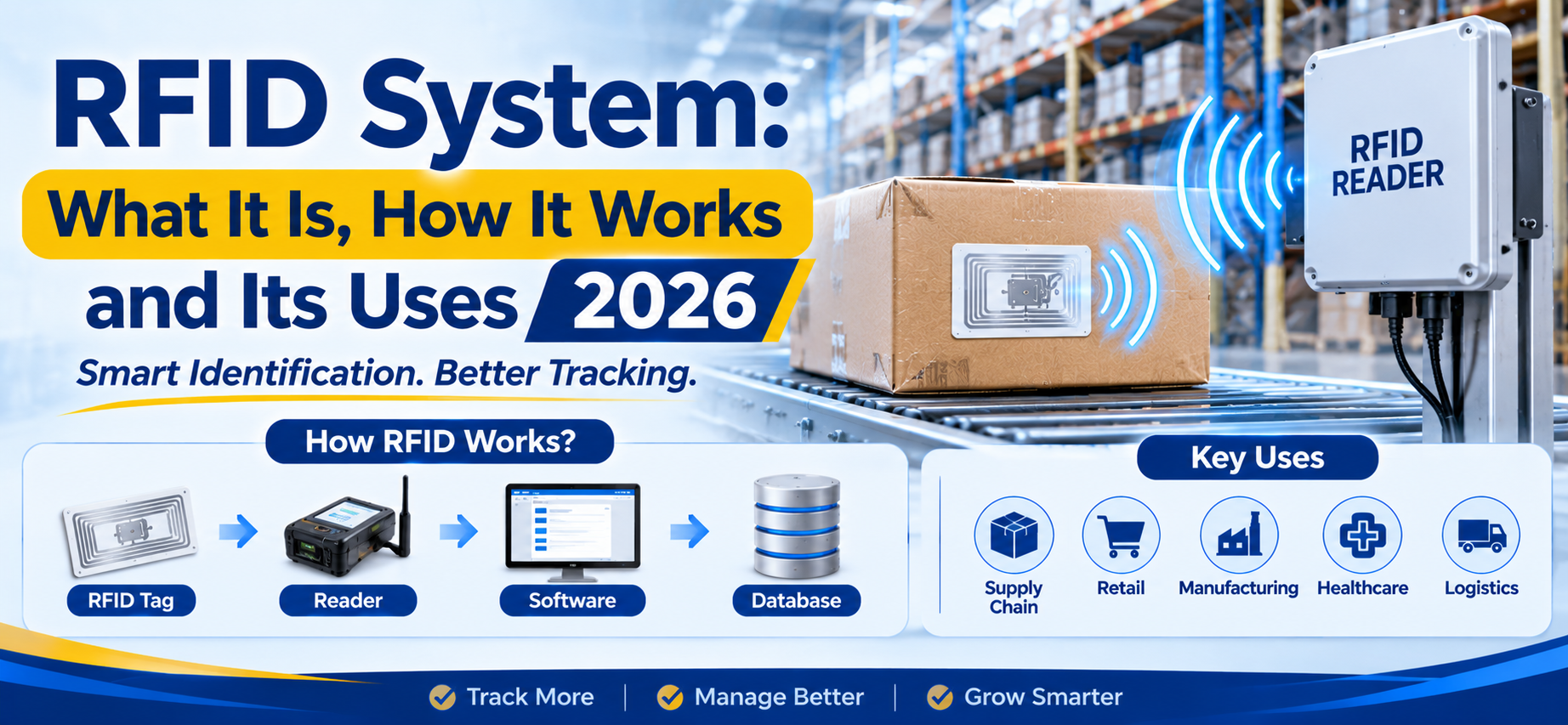
An RFID System is a powerful digital tool modern businesses use for automated data collection. By replacing slow manual scanning processes with advanced wireless technology, organizations can instantly identify objects and securely monitor shipments. This comprehensive guide explains exactly how this equipment operates and why it is essential for successfully achieving modern business efficiency in 2026.
What Is RFID?
Radio Frequency Identification is an advanced wireless communication method. An RFID System utilizes radio waves to automatically identify tagged objects. Unlike standard barcodes requiring direct line-of-sight scanning, this innovative technology can instantly capture data from multiple items simultaneously, making identification faster and highly accurate.
How Does It Work?
Understanding How RFID Works requires looking at signal transmission. The communication process within an RFID Tracking System relies entirely on radio frequencies. Readers send signals through antennas. When a tagged item enters this active radio field, it receives the signal and transmits unique identification data back. The reader captures this data and forwards it directly to the software database.
Types of RFID System
Active RFID Tags feature an internal battery, allowing them to broadcast signals continuously over long distances. They are perfect for large industrial yards.
- Passive RFID Tags lack an internal power source. They draw energy directly from the reader signal to transmit data. They are highly cost-effective for retail.
- Semi-Passive RFID features a small battery to power internal circuits but relies on the reader to transmit the actual signal for reliable medium-range tracking.
Main Components A reliable setup requires four distinct RFID Components:
- RFID Tags: Small computer chips with antennas attached to objects. They securely store unique item information.
- RFID Readers: Smart devices emitting and receiving radio signals to communicate with tagged items.
- RFID Antennas: Specialized equipment that amplifies the reader signal, extending the communication range.
- RFID Software: The backend platform processing captured information, turning raw scans into usable business data.
Common Uses :
Retail: Automates checkout processes and prevents inventory stockouts.
- Warehousing: Streamlines pallet tracking and warehouse logistics.
- Manufacturing: Monitors raw materials moving along assembly lines.
- Healthcare: Secures medical equipment and tracks patient records.
- Logistics: Automates shipping verification and delivery routing processes.
- Asset tracking: Quickly locates tools and returnable transport items.
- Libraries: Simplifies book checkouts and ensures automated document management.
Key Benefits
Implementing an RFID System provides substantial operational benefits. Organizations achieve near-perfect tracking accuracy by eliminating human error. It dramatically reduces manual labor time, offering faster identification since workers can scan hundreds of items instantly. Furthermore, businesses gain real-time inventory visibility and improved asset management capabilities, enabling faster decision-making, tighter security, and efficient business operations across multiple facilities.
RFID Solutions by AIDC
As a trusted provider of comprehensive AIDC Solutions, AIDC Technologies helps businesses implement customized tracking networks. Whether you need reliable RFID Technology hardware or full system integration, we supply the infrastructure. Our expertise spans robust Asset Management and advanced Warehouse Management deployments, ensuring your tracking infrastructure operates flawlessly. We specialize in effective RFID Inventory Management and accurate RFID Asset Tracking solutions.
Conclusion
An RFID System is a critical investment for modern organizations seeking long-term identification accuracy. By deeply understanding your specific operational requirements, you can successfully select the correct hardware to optimize daily workflows. Implementing these advanced tracking systems correctly ensures your growing business remains highly competitive and fully prepared for growth.
Visit the AIDC Technologies homepage or directly reach out through our dedicated Contact page to quickly build highly suitable RFID Solutions customized for your specific daily business requirements today.
FAQs
- What is an RFID System?
It is a wireless tracking framework using radio waves to identify tagged items and instantly collect accurate object data without manual scanning. - How does an RFID System work?
Readers send radio signals through antennas to communicate with tagged items, instantly capturing the stored identification data and sending it to a database. - What are the main types of RFID?
The three main categories are active, passive, and semi-passive systems. They differ based on internal power sources and effective scanning ranges. - What are the main components of RFID?
A functional setup requires tracking tags, signal antennas, communication readers, and backend processing software to capture and store data securely. - Where is RFID technology used?
It is deployed extensively in retail stores, industrial warehouses, manufacturing facilities, hospitals, logistics centers, and libraries to automate daily inventory tasks. - What are the benefits of using RFID?
Advantages include eliminated manual scanning, bulk reading capabilities, reduced labor costs, enhanced operational visibility, and significantly improved item data accuracy.