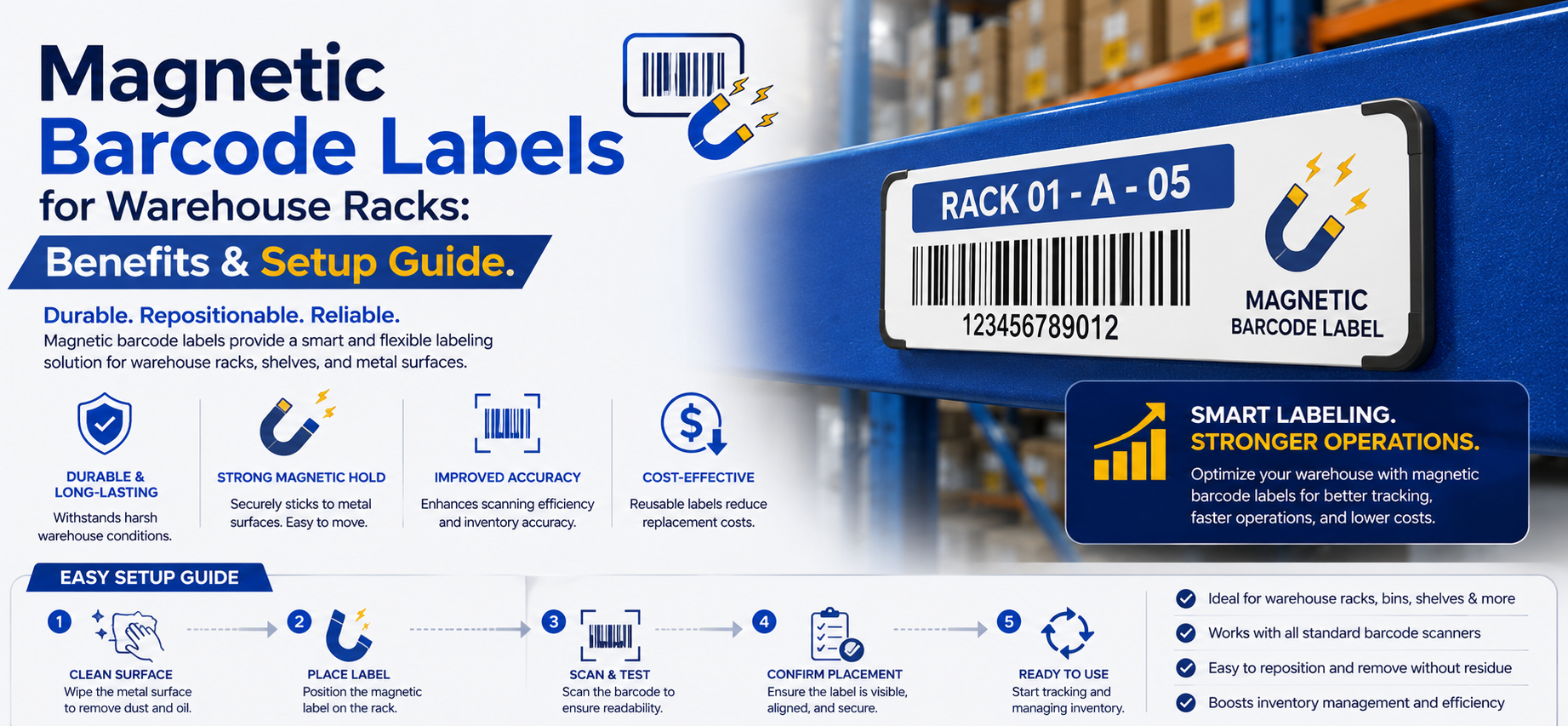
Magnetic barcode labels are industrial identification markers that utilize a flexible magnetic backing instead of traditional adhesive to attach to metal surfaces. In fast-paced warehouses and distribution centers, inventory locations and rack configurations change frequently to accommodate seasonal stock, new product lines, and optimized picking routes. When facility layouts shift, permanent adhesive labels become a significant operational bottleneck. Scraping off old stickers leaves behind a sticky residue that attracts dirt and makes applying new labels difficult.
Magnetic labels solve this problem by offering a repositionable and fully reusable solution for warehouse location identification. By upgrading to magnetic shelf tags, logistics and facility teams can instantly update rack identification without the hassle of scraping, cleaning, or constantly reprinting adhesive tags. – Aidc Technology
Key Advantages of Magnetic Barcode Tags.

Transitioning from traditional stickers to magnetic barcode labels offers several operational advantages for distribution centers that require dynamic shelf labeling:
- Flexibility: As inventory needs shift, warehouse staff can instantly lift and move a Rack Location Tag to a new bay or aisle without damaging the label or the racking system.
- Repositionability: If a label is placed crookedly or needs to be adjusted for better scanner alignment, it can be repositioned in seconds without losing its grip.
- Reusable Labeling: Because they are not destroyed upon removal, these labels can be deployed multiple times.
- Cost Over Time: This reusability helps reduce the recurring costs associated with continuously purchasing, printing, and applying single-use stickers during warehouse reorganizations.
- Zero Adhesive Residue: Magnetic backings leave metal racking beams completely clean. This eliminates the time-consuming process of scraping off glue and ensures the warehouse maintains a professional appearance.
- Easy Location Changes: Updating a warehouse layout takes a fraction of the time. Employees simply slide or transfer the label, streamlining the physical side of inventory relocation.
- Improved Warehouse Organization: Clean, properly aligned warehouse rack barcode labels ensure high visibility for forklift operators and pickers, directly supporting faster and more accurate inventory tracking.
Material Specifications: Cold-Storage, High-Strength Magnetics & Retro-Reflective Surfaces.

Selecting the correct material combination is critical for long-term durability. Warehouse managers must evaluate the facility’s environmental conditions, temperatures, visibility requirements, and handling workflows before procuring labels.
- Material/Feature: Flexible Magnetic Backing
- Best For: Standard indoor warehouse racking and general shelf labeling.
- Key Consideration: Magnetic strength must be sufficient to grip the steel beam firmly so the label is not easily knocked off by pallets or material handling equipment.
- Material/Feature: Cold Storage Rated Magnetics
- Best For: Refrigerated facilities, blast freezers, and cold-chain distribution centers.
- Key Consideration: Standard plastic and magnetic materials can become brittle in freezing
temperatures. Cold-storage formulations maintain their flexibility and adherence in extreme environmental conditions. - Material/Feature: Retro-Reflective Surfaces
- Best For: High-bay rack identification and long-distance barcode scanning.
- Key Consideration: These surfaces bounce scanner light directly back to the reader, allowing forklift operators to capture barcode data accurately without dismounting their vehicles.
Step-by-Step: Designing an Adaptable Warehouse Rack Labeling System.

Implementing a successful rack identification system requires a structured approach. Follow these steps to deploy your magnetic labels efficiently:
- Assess warehouse racks and storage locations: Confirm that your shelving is made of ferromagnetic metal. Heavy duty magnetic barcode labels for industrial steel shelving work perfectly, but they will not adhere to aluminum, plastic, or heavily coated racks.
- Create a consistent location identification structure: Develop a standardized alphanumeric naming convention (e.g., Aisle-Bay-Level-Position) for clear warehouse location identification.
- Select the appropriate magnetic label material: Choose cold-storage, retro-reflective, or standard flexible magnet backings based on your facility’s specific environmental conditions.
- Design readable barcode and location information: Ensure the barcode print quality is crisp and the alphanumeric text is large enough for human verification from a distance.
- Position labels for easy scanning and visibility: Place labels uniformly across all racks so pickers know exactly where to look, ensuring consistent line-of-sight.
- Test barcode readability and label placement: Conduct a test run with your actual barcode scanners to ensure seamless data capture from normal operating distances.
- Connect location labels with the warehouse or inventory management system: Ensure every physical Rack Location Tag corresponds accurately to your digital database to maintain precise inventory tracking.
- Update and reposition labels whenever warehouse locations change: Simply lift and move the reusable warehouse shelf labels to their new locations during any operational layout reconfiguration.
Magnetic Barcode Labels vs. Permanent Adhesive Labels:
Feature | Magnetic Barcode Labels | Permanent Adhesive Labels |
Repositionability | Highly repositionable; easily adjusted. | Cannot be repositioned once applied. |
Reusability | Fully reusable for future layout changes. | Single-use only; destroyed upon removal. |
Adhesive Residue | Leaves zero residue on racking surfaces. | Leaves sticky residue requiring chemical cleaning. |
Rack Relocation | Instant; simply lift and place in the new spot. | Slow; requires scraping old tags and applying new ones. |
Warehouse Reconfiguration | Fast and efficient, supporting dynamic operations. | Labor-intensive and disruptive to warehouse workflows. |
Suitable Applications | Industrial steel shelving, dynamic slotting, cold storage. | Permanent bins, non-magnetic surfaces, cardboard boxes. |
AIDC Technologies India provides advanced barcode, RFID, and automatic identification solutions that help businesses improve asset tracking, inventory accuracy, and operational efficiency.
Upgrade your warehouse labeling system with flexible magnetic barcode labels for faster, cleaner, and more accurate inventory tracking. Contact AIDC Technologies India today for the right solution.
Frequently Asked Questions
- What are magnetic barcode labels?
Magnetic barcode labels are identification tags backed with a flexible magnet rather than adhesive. They are used in warehouses to clearly mark metal racks and shelves, allowing for easy repositioning. - What are the benefits of magnetic barcode labels in warehouses?
The primary benefits are flexibility, reusability, and zero adhesive residue. They allow logistics teams to quickly update rack locations during layout changes without scraping off old stickers. - Are magnetic barcode labels reusable?
Yes, magnetic barcode labels are entirely reusable. Because they rely on magnetic attraction instead of chemical adhesives, they can be removed and relocated repeatedly without losing their effectiveness. - Can magnetic barcode labels be used on industrial steel shelving?
Yes, they are highly effective on industrial steel shelving. The ferromagnetic properties of steel warehouse racks provide an ideal surface for the magnetic backing to grip securely. - Are magnetic barcode labels suitable for cold storage?
Yes, provided they are cold storage rated. Specialized magnetic labels are formulated to withstand freezing temperatures without becoming brittle, curling, or losing their magnetic strength. - What are magnetic shelf tags used for?
Magnetic shelf tags are used for dynamic warehouse location identification. They help pickers, forklift operators, and automated systems locate specific product inventory on metal shelving. - How do magnetic barcode labels support inventory tracking?
They provide a scannable link between a physical location and the warehouse management system. By keeping locations clearly and accurately labeled as inventory moves, they reduce picking errors and improve efficiency. - What should businesses consider when choosing warehouse rack barcode labels?
Businesses should evaluate the rack surface material, warehouse temperature, required scanning distance, visibility needs, and how frequently their inventory storage locations change.