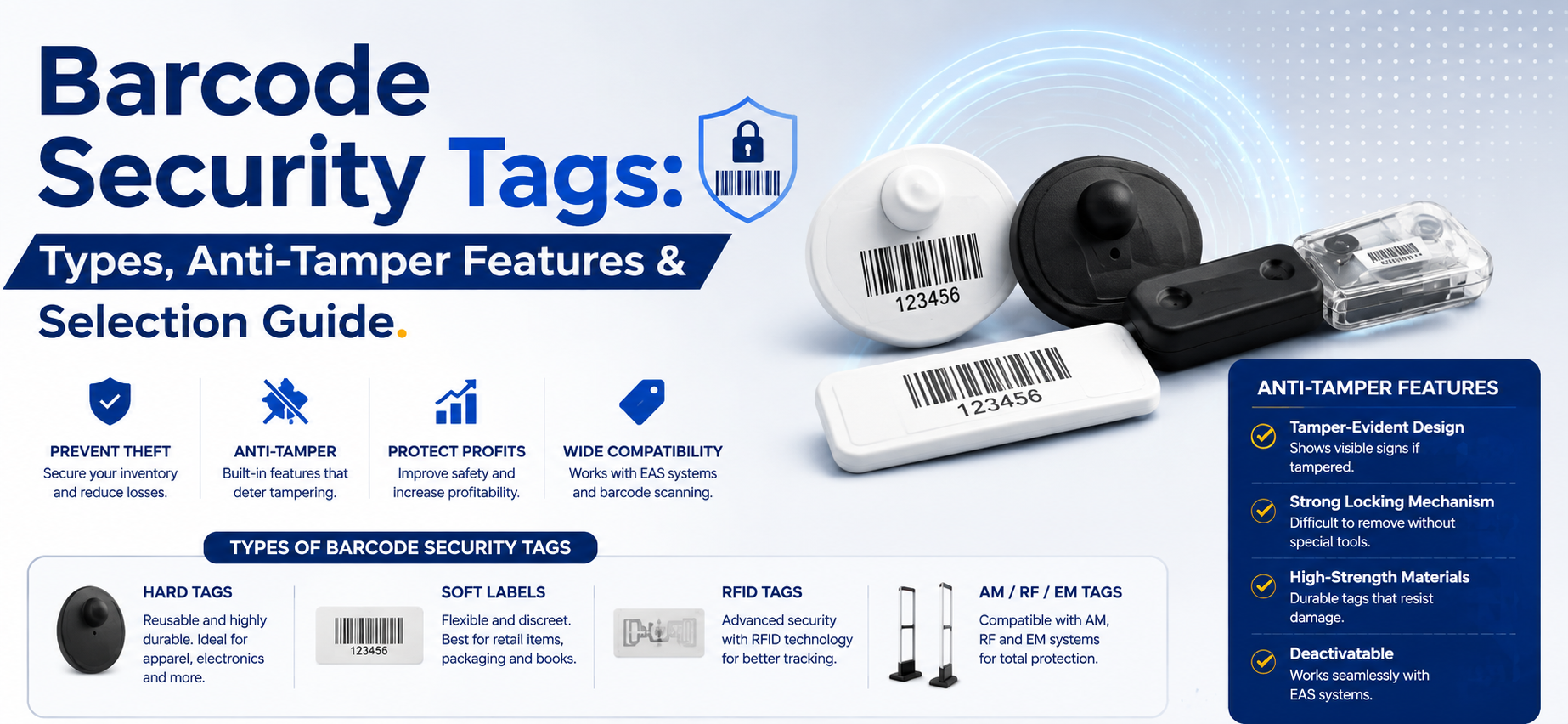
Barcode security tags are specialized adhesive labels designed to identify, manage, and protect corporate property. By combining traditional barcode identification with physical anti-tamper mechanisms, these labels offer a robust solution for asset tracking and inventory control. Businesses utilize them to secure IT equipment, manage warehouse inventory, and deter the unauthorized removal or transfer of valuable assets.
While no single label can completely eliminate theft, tamper evident barcode labels provide clear, irreversible visual evidence if someone attempts to peel, alter, or replace them. This visual deterrence ensures the ongoing integrity of an organization’s asset management database and helps security officers quickly identify compromised equipment during routine audits.– AIDC India
Core Types of Barcode Security Tags.

Selecting the correct material is critical for effective asset identification. Different surfaces and security requirements dictate which type of label will perform best. Here are the primary types of security labels used in commercial environments.
Destructible Vinyl Labels
- Tag Type: Destructible Vinyl Labels
- Security Feature: Manufactured with a fragile face stock that fragments into tiny pieces if removal is attempted, making it impossible to peel off and transfer the label intact.
- Best For: IT equipment, office assets, electronic devices, and warranty seals.
- Selection Consideration: Requires a clean, smooth surface for the high-tack adhesive to bond correctly. Because of its fragile nature, it should be placed in areas not subject to heavy, routine abrasion.
VOID Residue & Non-Residue Security Labels.
- Tag Type: VOID Security Labels
- Security Feature: Utilizes a specialized adhesive that separates upon peeling, revealing a hidden “VOID” pattern.
- Best For: Computers, server racks, secure packaging, and high-value corporate property.
- Selection Consideration: Businesses must choose between residue and non-residue options. Residue labels leave the VOID mark permanently on the physical asset, maximizing theft deterrence. Non-residue labels leave the surface clean, but the peeled label itself displays the VOID pattern, making them ideal for reusable surfaces like loaner laptops or temporary access points.
Metalized & Anodized Aluminum Asset Tags.
- Tag Type: Metallic and Aluminum Tags
- Security Feature: Exceptional structural durability paired with aggressive adhesives that resist physical scraping and environmental degradation.
- Best For: Heavy machinery, industrial equipment, warehouse racking, and outdoor assets.
- Selection Consideration: Anodized aluminum provides long-term identification in demanding environments. While they do not fragment like destructible vinyl, their extreme adhesion makes unauthorized removal incredibly difficult, protecting the asset tracking data in harsh industrial conditions.
Key Security Features to Look For.

When evaluating asset security tags, procurement specialists and asset managers should look for multiple layers of protection. Combining physical and visual security mechanisms ensures comprehensive asset protection.
- Tamper-Evident Construction: The core mechanism, whether utilizing a VOID pattern, destructible materials, or specialized security cuts that tear upon removal.
- High-Tack Adhesive: Ensures the tag bonds aggressively to challenging surfaces, immediately triggering the tamper mechanism if removal is forced.
- Unique Serial Numbers & Barcodes: Connects the physical item to your database, preventing a bad actor from swapping a tagged item with a visually identical, untagged replacement.
- Custom Holograms: Adds a visual authentication layer that is exceptionally difficult and expensive to counterfeit.
- UV Printing: Features invisible ink that only appears under ultraviolet light, allowing security officers to covertly verify authentic tags.
Selection Matrix: Matching Tag Material to Surface & Environment.
Tag Type | Best For | Key Security Feature | Surface/Environment Consideration |
Destructible Vinyl | Office electronics, warranty seals | Fragments into tiny pieces upon removal | Best on smooth indoor surfaces; avoid high-friction areas. |
VOID Residue | High-value IT hardware, fixed assets | Leaves permanent VOID mark on the asset | Ideal for permanent asset tagging where adhesive residue is acceptable. |
VOID Non-Residue | Loaner equipment, temporary access | VOID appears on label only, surface is clean | Good for temporary security needs and high-energy surfaces. |
Metalized Tag | General indoor/outdoor equipment | Metallic appearance, strong adhesion | Good middle-ground for moderate environmental exposure. |
Anodized Aluminum | Heavy machinery, industrial tools | Withstands abrasion and chemicals | Requires flat or gently curved surfaces; excellent for outdoor use. |
Barcode Security Tags for IT Asset Management.

Managing corporate technology requires high levels of precision. Organizations must track laptops, computers, servers, printers, and networking equipment across multiple locations while preventing unauthorized hardware swapping. By affixing security labels to these electronic devices, businesses can seamlessly connect physical hardware to their centralized asset tracking software.
When a barcode is scanned, the IT asset manager instantly accesses the device’s deployment history, maintenance records, and assigned user. Finding the best tamper-evident barcode tags for IT asset management usually comes down to selecting destructible vinyl or VOID residue tags. These specific materials provide the immediate visual evidence required to detect tampering during inventory audits, ensuring that expensive internal components and sensitive data-bearing devices remain secure and accounted for.
Looking for reliable barcode security tags for your assets? Contact AIDC India for the right tamper-evident barcode labeling solution for your business.
Frequently Asked Questions
- What are barcode security tags?
Barcode security tags are specialized adhesive labels used to identify and protect physical property. They combine scannable barcodes for database tracking with physical anti-tamper mechanisms to deter and expose unauthorized removal.
- What is a tamper-evident barcode label?
A tamper-evident barcode label is a tag designed to show irreversible, visible signs of interference if someone tries to peel it off. This ensures that a label cannot be secretly removed from one asset and applied to another.
- What is a VOID security label?
A VOID security label is a tag that reveals a hidden message—usually the word “VOID”—when peeled away from a surface. This instantly alerts inspectors that the asset’s security or warranty seal has been compromised.
- What is the difference between destructible vinyl and VOID labels?
Destructible vinyl breaks into tiny, irreparable fragments when scratched or peeled, whereas VOID labels remain structurally intact as a single piece but permanently reveal a hidden security pattern indicating they were removed.
- Are barcode security tags suitable for IT assets?
Yes, barcode security tags are highly suitable for IT assets. They allow organizations to efficiently scan computers, laptops, and servers during audits while actively deterring the theft or swapping of expensive hardware.
- What type of barcode security tag is best for metal equipment?
Anodized aluminum tags are best for metal equipment and heavy machinery. They feature industrial-grade adhesives and are specifically designed to withstand harsh chemicals, physical abrasions, and extreme environmental conditions.
- How do tamper-evident labels help with asset tracking?
Tamper-evident labels help with asset tracking by ensuring the identification barcode remains permanently associated with the correct physical item. If a label is moved, the tampering is immediately obvious, preventing database inaccuracies.
- What should businesses consider when choosing barcode security tags?
Businesses should consider the asset’s surface material, environmental exposure, adhesive requirements, and whether leaving a permanent residue on the item is acceptable for their specific operational workflow.