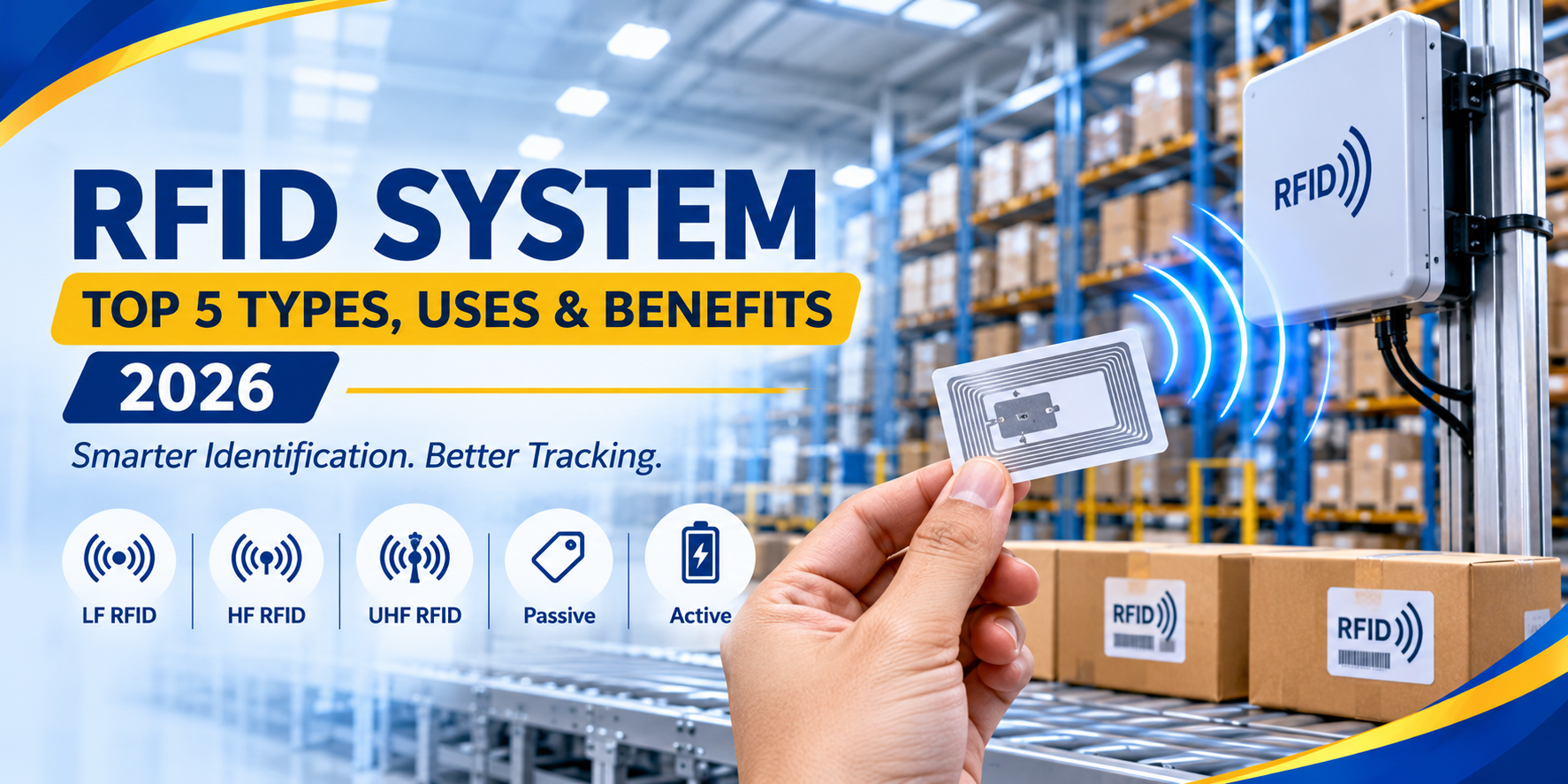
Businesses use an RFID System to identify products, monitor stock and track assets through radio-frequency communication. This RFID Technology allows RFID readers to capture information from tagged objects within their reading range, helping teams collect item data without scanning every label individually.RFID is employed in logistics, healthcare, manufacturing, retail, and warehouses.
What Is an RFID System?
RFID stands for Radio Frequency Identification. An RFID tag contains a microchip and antenna that communicate with RFID readers using radio waves. The reader sends captured identification data to connected software, where it can be matched with product or asset records.
For example, a reader at a warehouse receiving point can identify tagged cartons as they pass through. Unlike barcode scanning, RFID generally does not need direct line of sight, although performance depends on the equipment and environment.
Top 5 Types of RFID Systems
RFID Types are classified in two different ways: LF, HF and UHF describe operating frequency, while passive and active describe the tag’s power source. These categories are not mutually exclusive.
1. Low-Frequency RFID (LF)
LF RFID commonly operates around 125–134 kHz and has a short reading range. It is used for animal identification, access control and selected industrial applications. Its close-range operation suits situations where a tag is presented near a reader.
2. High-Frequency RFID (HF)
HF RFID operates at 13.56 MHz and is used in access cards, library systems, contactless identification and near-field applications. NFC is based on HF RFID technology. It is suitable when a user intentionally brings a card or device close to a reader.
3. Ultra-High-Frequency RFID (UHF)
UHF RFID generally operates in the 860–960 MHz range, with permitted frequencies varying by region. It can read tags from greater distances and identify multiple items in a read zone. Common uses include warehouse inventory, retail stock control and logistics.The performance can be influenced by metal, liquids, and tag orientation.
4. Passive RFID Systems
Passive RFID tags lack an internal battery and harness energy from the reader’s signal to send identification data.They suit product labelling, inventory management and item-level tracking. Reading range depends on the tag, frequency and reader setup.
5. Active RFID Systems
Active tags contain an internal battery and transmit signals using their own power. They support longer-range identification and periodic updates. Businesses may use them to track vehicles, containers and high-value equipment across large facilities. Battery life, cost and maintenance are important considerations.
Where Are RFID Systems Used?
RFID Applications differ by industry. Retailers use tags to improve stock visibility and support stock counts. Warehouses and logistics teams identify cartons, pallets and shipments during receiving and dispatch. Manufacturers track components during production, while healthcare facilities identify equipment and supplies. Organisations also use RFID to maintain records of asset location and movement.
Key Benefits of RFID Systems
An RFID Tracking System can speed up identification, reduce manual scanning, improve stock visibility and support asset tracking. These benefits depend on suitable tags, reader coverage, software integration and staff processes; poor tag placement or interference can still affect results.
Selecting the Appropriate RFID System
Consider the tracked objects, reading distance, frequency, tag type, nearby materials and environment. Check compatibility with existing inventory or warehouse software. Site testing can help confirm the right configuration and budget.
AIDC Technologies provides advanced RFID solutions for business identification and tracking. Its RFID tags, readers and integration services support efficient inventory management and asset tracking. These solutions help businesses improve stock visibility, data accuracy and daily operational efficiency.
For customised RFID solutions and tracking requirements, contact AIDC Technologies through its official website.
. For more information about our service and products visit kmsbarcode.
Conclusion
The right RFID System depends on the tracked objects, environment and business needs. LF, HF and UHF serve different frequency applications, while passive and active tags offer different power options. AIDC Technologies provides AIDC solutions for business identification and tracking requirements.
Frequently Asked Questions
1. What constitutes an RFID System and how does it operate?
It uses radio waves to exchange identification data between tags and readers. Software can match the captured data with business records.
2. What are the five main types of RFID technology discussed here?
The guide covers LF, HF and UHF frequency bands, plus passive and active tag power types.
3. What distinguishes passive RFID systems from active ones?
Passive tags draw energy from a reader’s signal.Active tags rely on a built-in battery to send out information.
4.Where are RFID systems commonly used?
They are utilized in retail, storage, logistics, production, healthcare, and asset monitoring.
5.What should businesses consider when choosing an RFID System?
Consider reading distance, frequency, tag type, environment, software integration, application needs and budget.