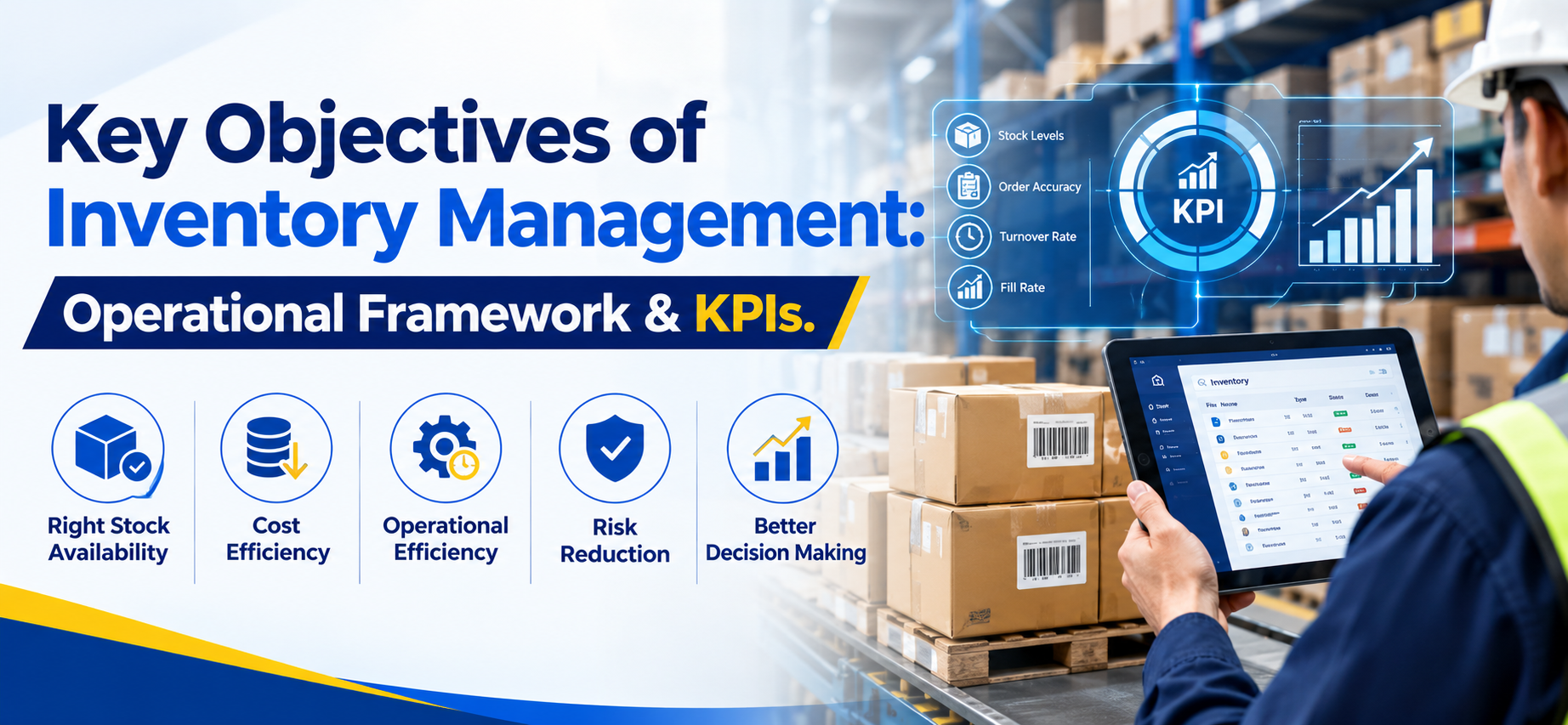
Effective inventory management is about maintaining the right products, in the right quantities, at the right time, while keeping storage and operational costs under control. Businesses must avoid two common problems: holding excessive stock that ties up capital and facing stockouts that interrupt sales, production, or customer fulfilment.
The objectives of inventory management provide a practical framework for achieving this balance. They help organisations control inventory investment, improve stock availability, use warehouse space efficiently, maintain accurate records, reduce waste, and support smooth supply-chain operations.
For supply chain teams, warehouse managers, procurement professionals, and business analysts, inventory management is not simply about counting products. It involves forecasting demand, setting reorder points, monitoring stock movement, controlling carrying costs, and using reliable data to make purchasing and operational decisions.
The 7 Primary Objectives of Inventory Management
1. Minimising Inventory Holding and Carrying Costs
One of the most important objectives is to keep inventory carrying costs under control without reducing product availability.
Inventory carrying costs can include:
- Warehouse storage expenses
- Insurance
- Handling and movement costs
- Capital invested in inventory
- Utilities and warehouse operating expenses
- Damage and deterioration
- Obsolescence
When companies hold more stock than necessary, these costs increase. However, reducing inventory too aggressively can create stockouts and fulfilment problems.
Businesses can manage carrying costs by using demand forecasting, Economic Order Quantity (EOQ), ABC analysis, Just-In-Time (JIT) approaches where appropriate, and regular reviews of slow-moving inventory.
Example: A retailer discovers that several low-demand products occupy valuable warehouse space for months. By analysing sales patterns and reducing unnecessary replenishment, the retailer frees storage capacity and reduces capital tied up in excess inventory.
Useful KPIs: Carrying Cost, Inventory Turnover Ratio, Days Inventory Outstanding (DIO), and Dead Stock Percentage.
2. Preventing Stockouts and Lost Sales
Stock availability is another core inventory control objective. A stockout occurs when a required product is unavailable when a customer or internal operation needs it.
Stockouts can result in:
- Lost sales
- Delayed customer orders
- Production interruptions
- Emergency procurement
- Lower service levels
- Increased transportation or purchasing costs
Organisations can reduce stockout risk by combining demand forecasting with reorder points and safety stock.
A reorder point is the inventory level at which a replenishment order should be triggered. A basic approach can be expressed as:
Reorder Point = Demand During Lead Time + Safety Stock
Safety stock provides additional protection against unexpected demand increases or supplier delays.
Example: A warehouse normally sells 100 units of a component per week. If supplier lead times vary, the company maintains safety stock so that a temporary delay does not immediately cause a stockout.
Useful KPIs: Stockout Rate, Order Fill Rate, Service Level, and Backorder Rate.
3. Optimising Storage Space Utilisation
Warehouse space is a valuable operational resource. Poor inventory organisation can cause congestion, inefficient picking, unnecessary movement, and difficulty locating products.
One of the key inventory optimisation goals is therefore to use available storage capacity effectively.
Businesses can improve space utilisation through:
- SKU classification
- Warehouse slotting
- ABC analysis
- Proper rack and bin organisation
- Vertical storage utilisation
- Standardized labeling
- Regular removal of obsolete stock
- Reviewing SKU storage requirements
Fast-moving products can be positioned closer to picking and dispatch areas, while slower-moving products may be stored in less accessible locations.
Example: A distribution centre identifies its highest-volume SKUs and relocates them closer to packing stations. Pickers travel shorter distances, improving workflow and making better use of the available warehouse layout.
Useful KPIs: Storage Utilisation Rate, Picking Productivity, Inventory Density, and Space per SKU.
4. Maintaining High Inventory Accuracy and Traceability
Accurate inventory records are essential for procurement, warehouse operations, sales, and financial planning. If system records show 500 units while the warehouse actually contains 430, purchasing and fulfilment decisions can be based on incorrect information.
Inventory accuracy can be improved through:
- Regular cycle counting
- Barcode scanning
- RFID technology
- Standardised receiving procedures
- Controlled stock movements
- Real-time inventory updates
- Location tracking
- Automated data capture
Traceability adds another layer of visibility by helping organisations identify where inventory came from, where it is stored, and where it has moved.
Example: A warehouse uses barcode scanning at receiving, storage, picking, and dispatch points. Each transaction updates the inventory record, reducing manual data-entry errors and improving stock visibility.
RFID can provide additional automation because tagged items can be identified without requiring each tag to be individually scanned in the same way as a traditional barcode.
Useful KPIs: Inventory Accuracy, Cycle Count Accuracy, Record Accuracy, and Inventory Visibility.
5.Enhancing Cash Flow and Working Capital Efficiency
Inventory represents money invested in products before those products generate revenue. Excess inventory can therefore restrict working capital.
One of the important inventory management objectives is to maintain sufficient stock for operational requirements without unnecessarily tying up cash.
Businesses can improve working capital efficiency by:
- Identifying slow-moving inventory
- Improving demand forecasting
- Adjusting purchasing quantities
- Reviewing supplier lead times
- Setting appropriate safety stock levels
- Monitoring inventory turnover
- Reducing unnecessary duplicate stock
Example: A manufacturer discovers that certain components are purchased in large quantities even though their consumption is relatively low. By reviewing order quantities and supplier terms, the company reduces excess stock while maintaining production requirements.
Useful KPIs: Inventory Turnover Ratio, DIO, Working Capital tied to Inventory, and Excess Inventory Percentage.
6. Reducing Waste, Obsolescence, and Theft
Inventory losses can occur through expiration, damage, deterioration, misplacement, obsolescence, or theft. These losses directly affect profitability and inventory accuracy.
Effective inventory control objectives should therefore include systematic loss prevention.
Useful controls include:
- Batch and expiry tracking
- FIFO or FEFO inventory practices where appropriate
- Barcode or RFID identification
- Restricted warehouse access
- Cycle counting
- Exception reporting
- Stock movement monitoring
- Regular obsolete-stock reviews
- Secure storage for high-value products
FIFO means First In, First Out, while FEFO means First Expired, First Out. FEFO can be particularly relevant where products have defined expiration dates.
Example: A healthcare distributor uses batch and expiry tracking to identify products approaching expiration. Inventory can then be prioritised appropriately, reducing avoidable product losses.
Useful KPIs: Shrinkage Rate, Dead Stock Percentage, Obsolete Inventory Value, Damage Rate, and Expired Stock Percentage.
7.Streamlining Production and Fulfilment Scheduling
Inventory management also supports production continuity and customer order fulfilment.
Manufacturers need appropriate quantities of raw materials, components, work-in-progress inventory, and finished goods. Warehouses need sufficient stock to fulfil customer orders without unnecessary delays.
Inventory planning can support scheduling by connecting:
Demand → Procurement → Receiving → Production → Storage → Picking → Fulfillment
Organisations can improve coordination by using demand forecasts, supplier lead-time information, reorder points, safety stock, MRP systems, WMS platforms, and real-time inventory data.
Example: A manufacturer monitors component inventory against its production schedule. When stock approaches the defined reorder point, procurement can begin replenishment before production is affected.
Useful KPIs: Order Fill Rate, On-Time Fulfilment, Production Downtime caused by Material Shortage, Supplier Lead Time, and Service Level.
Essential KPIs to Measure Inventory Management Success
Inventory KPIs turn inventory management objectives into measurable performance indicators. The right KPI set depends on the business model, product characteristics, service requirements, and supply-chain structure.
KPI | What It Measures | Why It Matters |
Inventory Turnover Ratio | How frequently inventory is sold or consumed | Indicates how efficiently inventory is being used |
Days Inventory Outstanding (DIO) | Average number of days inventory remains before being sold or consumed | Helps evaluate inventory investment |
Stockout Rate | Frequency of inventory shortages | Measures availability risk |
Inventory Accuracy | Difference between recorded and actual inventory | Supports reliable planning and fulfilment |
Carrying Cost | Cost of holding inventory | Helps control storage and capital costs |
Order Fill Rate | Percentage of demand fulfilled from available stock | Measures fulfilment performance |
Service Level | Ability to meet customer or operational demand | Indicates availability performance |
Dead Stock Percentage | Share of inventory with little or no movement | Helps identify obsolete or excess inventory |
Inventory Turnover Ratio
A commonly used formula is:
Inventory Turnover = Cost of Goods Sold ÷ Average Inventory
A higher turnover may indicate that inventory is moving efficiently, but the appropriate level varies considerably by industry and product category.
Days Inventory Outstanding
A simplified calculation is:
DIO = Average Inventory ÷ Cost of Goods Sold × Number of Days
DIO helps organisations understand approximately how long inventory remains invested before being sold or consumed.
Inventory Accuracy
Inventory accuracy compares the physical inventory with the quantity recorded in the inventory system.
For example:
Inventory Accuracy = Correctly Recorded Inventory Items ÷ Total Items Checked × 100
A consistent measurement process allows warehouse teams to identify recurring discrepancies and investigate their causes.
Order Fill Rate
Order fill rate measures how much customer demand can be fulfilled from available inventory.
For example:
Order Fill Rate = Orders Fulfilled Completely ÷ Total Orders × 100
This KPI connects inventory availability directly with fulfilment performance.
Practical Strategies for Better Inventory Management
Businesses can strengthen their inventory processes by:
- Improving demand forecasting
- Setting data-based reorder points
- Using safety stock strategically
- Applying ABC inventory analysis
- Conducting regular cycle counts
- Monitoring supplier performance
- Automating inventory tracking
- Reviewing slow-moving and obsolete stock
- Tracking inventory KPIs consistently
Combining these practices with appropriate technology creates a more controlled and measurable inventory operation.
Conclusion
The objectives of inventory management provide a practical framework for balancing availability, cost, warehouse efficiency, cash flow, and customer service. By combining demand planning, inventory controls, measurable KPIs, and technologies such as barcode and RFID, organisations can build more accurate and responsive inventory operations.
Contact AIDC India for practical inventory tracking, barcode, RFID, and warehouse management solutions tailored to business requirements.
For inventory visibility and automated data capture requirements, visit AIDC India to discuss suitable technology options.
Lorem ipsum dolor sit amet, consectetur adipiscing elit. Ut elit tellus, luctus nec ullamcorper mattis, pulvinar dapibus leo.
Frequently Asked Questions
1. What are the main objectives of inventory management?
The main objectives include controlling carrying costs, preventing stockouts, optimising warehouse space, maintaining inventory accuracy, improving working capital efficiency, reducing waste and shrinkage, and supporting production and fulfilment.
2. What is the primary objective of inventory control?
A central purpose of inventory control is to maintain the appropriate quantity of inventory while minimising unnecessary costs and ensuring products or materials are available when required.
3. Why is inventory management important for businesses?
Effective inventory management helps businesses balance product availability with inventory investment. It can support better cash flow, warehouse efficiency, order fulfilment, purchasing decisions, and customer service.
4. How does technology improve inventory management?
Technology such as barcode systems, RFID, WMS platforms, automated data capture, and inventory software can improve stock identification, inventory accuracy, traceability, visibility, and operational efficiency.
5. What KPIs are used to measure inventory management?
Common inventory KPIs include Inventory Turnover Ratio, DIO, Stockout Rate, Inventory Accuracy, Carrying Cost, Order Fill Rate, Service Level, and Dead Stock Percentage.