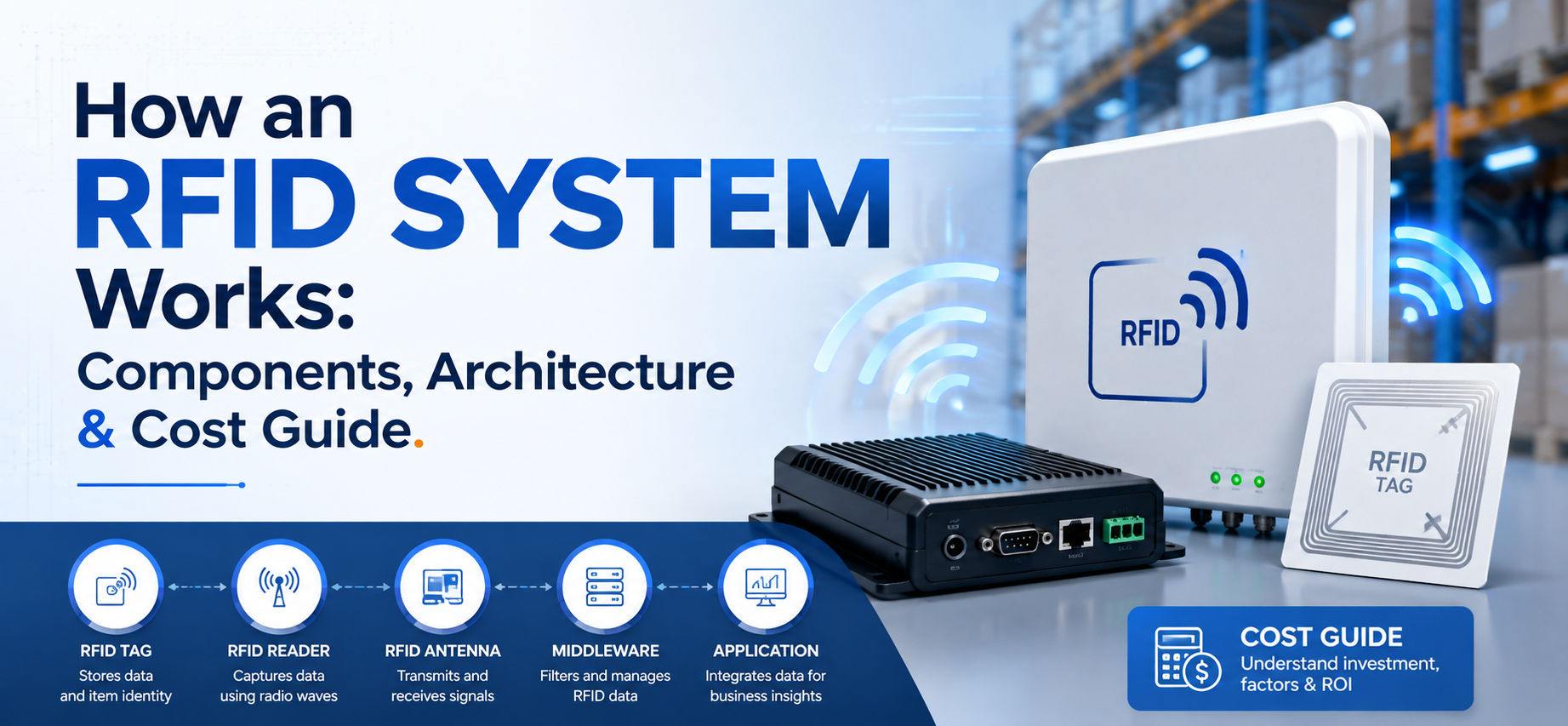
An RFID system (Radio Frequency Identification) is an automated data-capture technology that uses radio waves to identify, track, and locate objects in real time. Unlike simple barcodes that require a direct line of sight, an RFID deployment allows businesses to scan hundreds of items simultaneously without manual intervention.
However, an enterprise-grade RFID solution involves far more than just sticking tags onto pallets. It requires an integrated ecosystem of specialized hardware, signal processing, and enterprise software. For operations managers, supply chain directors, and IT teams, deploying asset tracking RFID technology transforms raw inventory movements into actionable business intelligence, dramatically reducing labor costs and eliminating shrinkage.
The 4 Essential Components of an Enterprise RFID System.
A fully functional enterprise RFID system relies on four distinct hardware and software layers working in unison.
[ RFID Tag / Transponder ]
│ (Radio Waves)
▼
[ RFID Antenna & Reader/Interrogator ]
│ (Raw Digital Data)
▼
[ RFID Middleware ]
│ (Filtered Events)
▼
[ Host Systems: ERP / WMS / Database ]
1. RFID Tags & Transponders
At the edge of the system is the transponder, commonly referred to as the RFID tag. Attached to products, assets, or shipping containers, tags contain a microchip for storing data and a tiny antenna for transmitting it.
- Passive Tags: Powered entirely by the electromagnetic energy emitted by the reader. They carry no internal battery, offering a lower cost per unit and an virtually unlimited lifespan. They are ideal for high-volume inventory tracking.
- Active Tags: Feature an internal battery that continuously broadcasts signal data. They provide long read ranges (up to hundreds of meters) and are used for tracking high-value assets like heavy machinery, vehicle fleets, or shipping containers.
- Semi-Passive Tags: Use an internal battery to power the microchip’s internal logic while relying on the reader’s power to bounce back the signal, often paired with environmental sensors (e.g., temperature tracking).
2. RFID Readers & Antennas
The reader—also known as an interrogator—is the central communications hub. It emits radio signals through connected antennas to activate nearby tags and collect their data.
- Fixed Readers: Mounted at strategic choke points such as loading docks, warehouse doorways, or conveyor belts to track inventory movement automatically.
- Handheld Scanners: Mobile units operated by warehouse staff for manual cycle counts, audit checks, or stock picking.
- Antennas: Convert the reader’s electrical signal into radio waves broadcast into the environment, and vice versa. The shape, angle, and gain of the antenna define the effective read zone.
3. RFID Middleware & Integration Software
Raw reader data is noisy; a single tagged item resting near a reader can generate thousands of redundant scans per minute. RFID middleware acts as the system’s brain. It cleanses this continuous stream, filters out duplicate reads, aggregates data events, and translates raw hex strings into meaningful business logic (e.g., “Pallet #4092 entered Gate 3”).
4. Host Database & ERP Systems
Finally, cleansed data passes from the middleware into core enterprise applications—such as a Warehouse Management System (WMS), Enterprise Resource Planning (ERP) platform, or specialized asset tracking software. This integration provides stakeholders with real-time operational visibility across global supply chains.
How RFID Systems Read Data (Frequency Ranges Explained)
RFID deployments operate across different frequency bands, each suited to distinct operational environments:
Frequency Band | Operating Range | Best Use Cases |
Low Frequency (LF) | 125 – 134 kHz (~10 cm) | Animal tracking, access control, metal-heavy environments |
High Frequency (HF / NFC) | 13.56 MHz (Up to 1 meter) | Ticketing, smart cards, item-level pharmacy tracking |
Ultra-High Frequency (UHF) | 860 – 960 MHz (Up to 12+ meters) | Supply chain, warehouse management, asset tracking |
For enterprise operations, Ultra-High Frequency (UHF) standard (specifically RAIN RFID) is the industry benchmark. UHF offers high-speed data transfer rates and extended read ranges, allowing an entire pallet of goods to be inventoried in seconds as it passes through a dock door.
RFID System Architecture & Data Flow.
Understanding the RFID system architecture helps IT specialists design robust workflows. Data moves through five precise stages:
- Signal Emission: The reader sends electromagnetic energy through its antenna.
- Tag Activation: Passive tags entering the radio field absorb energy, energizing their microchip.
- Data Response: The tag backscatters its unique Electronic Product Code (EPC) back to the antenna.
- Middleware Processing: The reader sends raw signals to the middleware, which removes duplications and verifies tag location.
- System Ingestion: Processed events update inventory counts in the ERP/WMS instantly.
Real-World Cost Breakdown & ROI Factors.
Determining the cost of an RFID system requires evaluating both initial capital expenditure and ongoing operational costs:
- RFID Tags: Consumable costs vary significantly based on volume and ruggedness (from standard paper labels to durable, on-metal hard tags).
- Readers and Antennas: Fixed portal setups and industrial mobile handhelds represent the bulk of hardware investment.
- Middleware & Software: Licensing fees vary depending on whether you choose an on-premises platform or a cloud SaaS model.
- Integration & Deployment: Professional services for site surveys, custom API development, and network integration.
- Maintenance & Support: Hardware warranties, firmware updates, and ongoing technical support.
Primary ROI Drivers: Labor reduction in cycle counting, elimination of shipping errors, improved loss prevention, and maximized asset utilization across facilities.
Common Deployment Pitfalls & Environmental Interference.
Deploying an active vs passive RFID system in a warehouse setting requires navigating several physical and structural challenges:
- Metal & Liquid Interference: Water absorbs UHF energy, while metal reflects it. Special on-metal tags or tuned antennas are necessary near dense liquids or steel racking.
- Poor Read-Zone Design: Overlapping RF signals can lead to stray reads (reading tags on a adjacent shelf unintentionally).
- Inadequate Site Testing: Skipping a thorough RF site survey often leads to dead zones and missed tag reads during peak operations.
- Lack of User Training: Without proper operational workflows, staff may fall back on manual workarounds, negating the system’s speed advantage.
AIDC India provides RFID and automatic identification solutions designed to help businesses improve inventory visibility, asset tracking, warehouse operations, and supply chain efficiency. From RFID tags and readers to complete system integration, AIDC India supports businesses in selecting and implementing solutions suited to their operational requirements.
Follow AIDC India on Instagram for the latest RFID solutions, industry insights, automation tips, product updates, and smart identification technology.
Looking to implement an RFID system for your business? Contact AIDC India for expert guidance on RFID tags, readers, software integration, and complete RFID solutions tailored to your operational needs.
Frequently Asked Questions.
- What is the difference between RFID systems and barcode systems.
Barcodes require a direct optical line of sight and must be scanned one by one. An RFID system reads multiple tags simultaneously over greater distances without direct sightlines, enabling bulk processing. - What is the maximum read range of an RFID system?
Passive UHF systems typically reach ranges of 3 to 12 meters (10 to 40 feet). Active RFID systems powered by internal batteries can exceed 100 meters (300+ feet). - What are the main parts of an RFID system?The four essential parts are the RFID tags, readers/antennas, middleware software, and the host enterprise system (ERP/WMS).
- How much does an RFID system cost to implement?
Total costs depend heavily on deployment scale, tag volume, hardware durability requirements, and integration complexity. A single-dock portal pilot differs vastly from a global, multi-facility warehouse automation project.