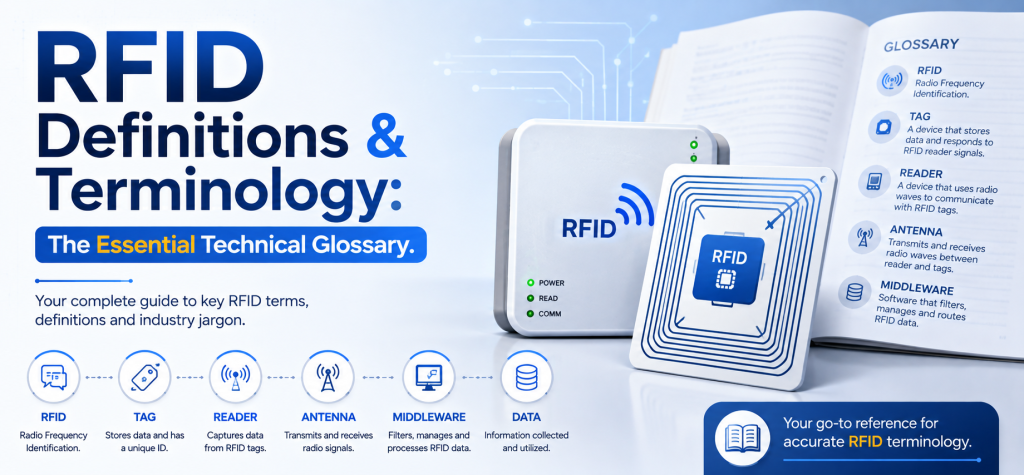
Understanding basic RFID definitions and technical terms is crucial for supply chain directors, logistics analysts, and procurement specialists evaluating asset tracking or warehouse automation projects. Radio Frequency Identification (RFID) relies on specific hardware, frequency physics, and software protocols.
This categorised RFID dictionary provides clear, self-contained definitions to help you navigate vendor discussions, technical specifications, and system deployments.
Quick Navigation
Hardware Terminology:
- RFID Tag: A small device containing a microchip and integrated antenna used to store and transmit data wirelessly.
- Practical Role: Attached to assets, pallets, or merchandise to enable automated identification without a direct line of sight.
- Transponder: The technical term for an RFID tag, derived from “transmitter/responder.”
- Practical Role: Automatically emits stored data back to an RFID reader upon receiving a radio frequency interrogation signal.
- Interrogator: An electronic device, commonly called an RFID reader, that transmits and receives radio signals.
- Practical Role: Powers passive tags, captures their transmitted data, and transfers that raw information to a central database.
- Inlay: The functional core of an RFID tag, consisting of a microchip attached to an antenna printed on a substrate film.
- Practical Role: Served as “dry” (no adhesive) or “wet” (with adhesive) components converted into finished smart labels or hard tags.
- RFID Antenna: A specialised conductor that converts electrical signals from a reader into radio waves and vice versa.
- Practical Role: Shapes the size, direction, and intensity of the effective read zone in a warehouse or facility.
- Encapsulation: The protective casing (such as rugged plastic, silicon, or glass) placed around an RFID inlay.
- Practical Role: Protects internal electronics from extreme heat, moisture, physical impact, and chemical exposure in harsh environments.
Signal & Frequency Terms:
- UHF (Ultra-High Frequency): RFID systems operating between 860 MHz and 960 MHz.
- Impact: Offers long read ranges (up to 12+ meters) and fast data transmission rates, making it the standard for supply chain tracking.
- Impact: Offers long read ranges (up to 12+ meters) and fast data transmission rates, making it the standard for supply chain tracking.
- HF (High Frequency): RFID systems operating at 13.56 MHz, including Near Field Communication (NFC).
- Impact: Provides short-range transfer (under 1 meter) with high data security, ideal for library books and payment cards.
- Impact: Provides short-range transfer (under 1 meter) with high data security, ideal for library books and payment cards.
- LF (Low Frequency): RFID systems operating between 125 kHz and 134 kHz.
- Impact: Features short read distances (under 10 cm) but penetrates liquids and metals better than higher frequencies.
- Impact: Features short read distances (under 10 cm) but penetrates liquids and metals better than higher frequencies.
- Attenuation: The reduction or loss of radio signal strength as it travels through space or materials.
- Impact: Dense materials like water or metal cause signal attenuation, requiring specialised tag selection or antenna placement.
- Impact: Dense materials like water or metal cause signal attenuation, requiring specialised tag selection or antenna placement.
- Multipath: A physical phenomenon where radio signals reflect off metallic or hard surfaces, arriving at the reader along multiple paths.
- Impact: Can cause signal interference or phantom reads, requiring precise site tuning during deployment.
- Impact: Can cause signal interference or phantom reads, requiring precise site tuning during deployment.
- Near-Field Coupling: Energy transfer between an RFID tag and reader antenna via magnetic induction over very short distances.
- Impact: Enables reliable short-range reads even in environments densely populated with metal or liquids.
Software & Data Terms:
- EPC (Electronic Product Code): A standardised global identifier stored on an RFID microchip that uniquely distinguishes an individual item.
- Context: Unlike standard UPC barcodes that identify product categories, an EPC uniquely identifies a specific item in a global database.
- Context: Unlike standard UPC barcodes that identify product categories, an EPC uniquely identifies a specific item in a global database.
- EPC Gen2 / Gen2: The universal industry standard (ISO 18000-6C) for passive UHF RFID hardware and communications protocols.
- Context: Ensures global interoperability between tags, readers, and software vendors.
- Context: Ensures global interoperability between tags, readers, and software vendors.
- RFID Middleware: Software positioned between RFID readers and enterprise management platforms.
- Context: Cleans raw reader signals, filters out duplicate reads, and transforms tag events into actionable ERP or WMS updates.
- Context: Cleans raw reader signals, filters out duplicate reads, and transforms tag events into actionable ERP or WMS updates.
- Encoding: The process of writing unique data—such as an EPC number—onto an RFID tag’s microchip.
- Context: Performed automatically during label printing or manually via handheld scanners during asset onboarding.
- Context: Performed automatically during label printing or manually via handheld scanners during asset onboarding.
- Read Rate: The total number of individual RFID tags correctly scanned and decoded within a specific timeframe.
- Context: Serves as a key performance indicator (KPI) for evaluating RFID system accuracy in fast-moving environments.
Practical Application Terms:
- Read Zone: The designated 3D boundary where an RFID reader antenna can reliably power and scan tags.
- Context: Designed around dock doors, conveyor belts, or entry portals to capture inventory movement.
- Context: Designed around dock doors, conveyor belts, or entry portals to capture inventory movement.
- Bulk Scanning: Scanned identification of multiple tagged items simultaneously without requiring individual, item-by-item manual handling.
- Context: Allows an entire pallet of boxed merchandise to be inventoried in seconds as it enters a warehouse.
- Context: Allows an entire pallet of boxed merchandise to be inventoried in seconds as it enters a warehouse.
- Anti-Collision Protocol: An algorithm that prevents radio signals from multiple nearby tags from interfering with one another during scanning.
- Context: Enables an interrogator to distinguish and read hundreds of individual tags per second in proximity.
- Context: Enables an interrogator to distinguish and read hundreds of individual tags per second in proximity.
- Asset Tracking: Using RFID systems to monitor the real-time location, identity, and status of fixed or mobile physical assets.
- Context: Applied to returnable transport items, tools, IT equipment, and heavy machinery across facilities.
- Context: Applied to returnable transport items, tools, IT equipment, and heavy machinery across facilities.
- Inventory Tracking: The continuous tracking of stock levels, goods movements, and product locations within a supply chain.
- Context: Dramatically increases stock accuracy while eliminating labour-intensive manual cycle counts.
At AIDC India, we help businesses understand and adopt RFID technology with practical solutions for identification, tracking, inventory management, and automation. Whether you are exploring RFID for the first time or planning an enterprise deployment, our team can help you understand the technology and identify the right solution for your application.
Follow AIDC India on Instagram to learn more about RFID technology, industry terminology, automation solutions, and the latest developments in identification and tracking.
Have questions about RFID terminology or need help selecting the right RFID solution? Contact AIDC India for professional assistance with RFID technology, products, and implementation.
Frequently Asked Questions.
- What is RFID in simple terms?
RFID (Radio Frequency Identification) is a wireless technology that uses radio waves to automatically identify, locate, and track objects tagged with microchips over short or long distances.
- What is the definition of active RFID vs passive RFID tags?
An active RFID tag contains an internal battery to continuously broadcast its own signal over long distances. A passive RFID tag has no battery and relies entirely on radio energy emitted by a reader to power up and reflect back its data.
- What is an RFID transponder?
An RFID transponder is the technical name for an RFID tag. It receives a radio interrogation signal from a reader and automatically responds by transmitting its stored digital payload.
- What is RFID attenuation?
RFID attenuation refers to the weakening or absorption of radio frequency signal strength as it passes through environmental barriers such as water, dense liquids, or physical obstructions.
- What is UHF RFID?
UHF RFID operates on the Ultra-High Frequency band (860–960 MHz). It delivers extended read ranges and high-speed multi-tag scanning, making it the dominant technology for inventory management and supply chains.
- What is an RFID interrogator?
An RFID interrogator is a device—commonly called an RFID reader—that emits radio signals to activate tags, read their data, and relay that information to software platforms.
- What is RFID middleware?
RFID middleware is software that processes, cleans, and aggregates raw data streams from RFID readers, filtering duplicates before forwarding structured data to business software like a WMS or ERP.
- What is an anti-collision protocol in RFID?
An anti-collision protocol is an algorithm built into RFID tags and readers that manages signal timing, allowing readers to distinguish and process hundreds of overlapping tag responses simultaneously without data corruption.